
How to Reach Benalmadena by Train
Affiliate disclosure: This article contains affiliate links. If you click through and make a purchase, Stafford Affiliates Travel may earn a commission at no extra cost to you.
If you are planning a Costa del Sol break and want the simplest public transport option, here is how to reach Benalmadena by train without overcomplicating it. For most travellers, the answer is straightforward: fly into Málaga-Costa del Sol Airport, follow the signs to the suburban rail station, and take the C1 line towards Fuengirola.
That sounds easy enough, but a few details matter. Benalmádena is served by more than one station, tickets work slightly differently depending on where you start, and the best stop for you depends on whether you are heading for the marina, Arroyo de la Miel, or a hotel up in the hills. Getting those details right can save you time, a taxi fare, and the usual arrival-day confusion.
How to reach Benalmadena by train from Málaga Airport
For UK travellers arriving by air, this is usually the quickest and least wasteful transfer option. Málaga Airport has its own railway station connected to Terminal 3, and the C1 Cercanías line runs directly along the coast.
You do not need a long-distance train reservation. This is a local commuter service, designed for practical point-to-point travel between the airport, Málaga city and resorts such as Torremolinos, Benalmádena and Fuengirola. Trains are regular, journey times are short, and you avoid motorway traffic, which can be unreliable in busy periods.
From the airport, buy your ticket from the machine or ticket desk, then board a train marked for Fuengirola. Benalmádena sits on that route, so there is no need to change. Depending on which station you need, the trip is normally around 15 to 25 minutes.
If you are tired after a flight, the main thing to check before getting on is the station name. Benalmádena has two stations commonly used by visitors: El Pinillo and Arroyo de la Miel. Arroyo de la Miel is the better-known stop for most holiday stays, but El Pinillo can make more sense for some hotels and flats near the border with Torremolinos.
Essential Ticketing & Payment Options
The C1 line offers highly flexible payment methods. You do not strictly need to buy a traditional paper ticket before boarding:
- Contactless Credit or Debit Cards: You can pay directly at the station gates by tapping your contactless bank card, mobile phone, or smartwatch. If a station does not have physical barrier gates, you must actively locate the small, standalone card readers installed on the platform to tap in before boarding.
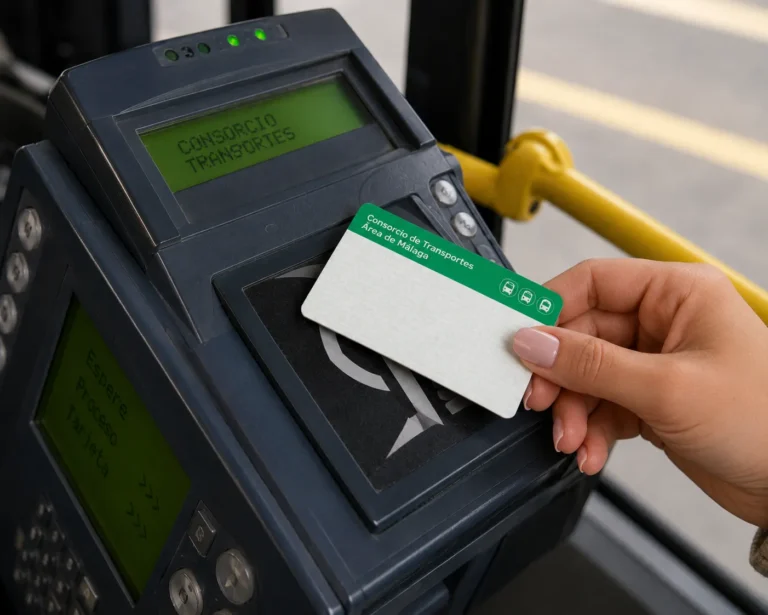
- The Green ‘Consorcio’ Card (Tarjeta del Consorcio): This reusable, multi-person travel card is issued by the Málaga Metropolitan Transport Consortium. It offers heavily discounted fares across buses and trains and is easily purchased or topped up at local tobacconists (Estancos) and station machines. It is also possible to buy this card from the bus ticket office to the right as you walk out of the arrivals hall during its operating hours, you will need cash for this.
- The Renfe €20 Unlimited Pass (Abono de Cercanías): For frequent travellers, Renfe offers a recurring travel pass costing €20 that grants unlimited travel across the local network for up to four months. A deposit is required, which is fully refundable if you make at least 16 individual journeys during the validity period.
The Golden Rule: Remember to Tap Out
If you choose to use a contactless bank card, phone, or the green Consorcio card, it is absolutely vital that you tap out again when leaving your destination station. This applies universally, even at quiet or open-plan stations that lack physical barriers. On un-barriered platforms, you must find the small card reader and scan your card before exiting. If you fail to tap out, the system cannot calculate your journey length, resulting in a maximum fare penalty charge or a potential fine from ticket inspectors.
Which Benalmadaena station should you use?
This is where planning makes the journey feel much easier. Benalmádena is not a single compact centre, so the right station depends on where you are staying.
Arroyo de la Miel
For many visitors, Arroyo de la Miel is the most useful station. It gives you access to the town centre area, local shops, restaurants, and transport connections. If you are staying near Tivoli area accommodation, Parque de la Paloma, or parts of Benalmádena Costa, this is often the best place to get off.
It is also a practical stop if you plan to continue by bus or short taxi ride. Benalmádena has some steep roads, so a hotel that looks close on a map can still feel awkward with luggage. If your accommodation is uphill, factor that in rather than assuming you can walk comfortably in the heat.
El Pinillo
El Pinillo is the earlier stop if you are coming from Málaga direction. It can suit accommodation in the western side of Benalmádena Costa or places edging towards Torremolinos. It is usually less central for first-time visitors, but sometimes it is the more efficient option.
If you are staying in a holiday rental, check the full address rather than relying on the area name alone. Hosts often describe properties as being in Benalmádena when the most convenient station might not be the obvious one.
How to reach Benalmadena by train from Málaga city
If you are already in Málaga city, the process is just as simple. Board the C1 line towards Fuengirola from a central station on the route, such as Málaga Centro Alameda or Málaga María Zambrano, and stay on until your chosen Benalmádena stop.
This is useful if you are splitting your trip between city and coast, or if you arrive in Málaga by mainline rail from elsewhere in Spain. In that case, you usually transfer from the national rail services to the local Cercanías network rather than taking a direct long-distance train into Benalmádena itself.
That distinction matters. Benalmádena does not have a high-speed rail station, so if you are travelling from Madrid, Córdoba or Seville, you will generally arrive first in Málaga María Zambrano and then continue on the local line.
Can you reach Benalmádena by train from elsewhere in Spain?
Yes, but not usually on one train. If you are travelling from another Spanish city, the realistic route is to take a mainline service to Málaga and then change to the C1.
For example, a traveller coming from Madrid would typically use a high-speed service to Málaga María Zambrano. From there, the onward connection to Benalmádena is easy, but it is still a separate leg of the journey. Allow a little buffer time if you are carrying luggage or travelling with children, especially in peak season.
This is one of those cases where train travel is still convenient, just not fully door to door. The trade-off is that rail tends to be more comfortable and lower-impact than hiring a car for the whole trip, particularly if your plan is mainly beach time rather than extensive inland touring.
Tickets, timings and what to expect
The C1 line is designed for ordinary local travel, so ticketing is usually uncomplicated. You buy a ticket for the relevant journey, pass through the barriers, and keep it until the end because you may need it to exit at your destination station.
Trains normally run frequently throughout the day, though exact intervals vary. Early morning and late evening services can be less frequent than daytime ones, so if you have a very early flight home or a late arrival, it is worth checking the current timetable before you travel.
Carriages are functional rather than luxurious. Think commuter rail, not long-distance comfort. There is space for passengers with cases, but if several flights have landed close together, trains from the airport can get busy. If you are travelling as a family with pushchairs and multiple bags, patience helps.
Air conditioning is usually available, which matters in summer. Even so, platforms and station access can feel hot, so keep water handy and avoid packing in a way that leaves you juggling loose items.
Common mistakes to avoid
The biggest mistake is assuming the closest station on the map is always the easiest one to use. Benalmádena’s layout includes hills, dual carriageways and resort-style roads that are not always pleasant on foot. A five-minute drive can turn into a sweaty 20-minute drag with suitcases.
Another common issue is confusion between Benalmádena Pueblo and the train stations. The traditional whitewashed village area sits inland and uphill, and there is no train station right in the pueblo. If you are staying there, you can still come by train to Arroyo de la Miel and continue by taxi or bus, but you should not expect a simple flat walk.
It is also worth checking whether your accommodation is in Benalmádena Costa, Arroyo de la Miel or the pueblo. These are all part of the same municipality, but they feel quite different on arrival day.
Is the train the best option?
For many travellers, yes. If you are arriving at Málaga Airport and staying near a station or only need a short onward taxi, the train is usually the best balance of cost, speed and ease. It is also a sensible lower-waste choice compared with a private transfer for a short coastal hop.
That said, it depends on your group and your accommodation. If you land very late, have mobility needs, or are staying in a hillside villa with no easy local access, a direct transfer may be more practical. The train works best when your final stop is reasonably close to the station, not when it leaves you with a difficult last mile.
For independent travellers, though, it is one of the least stressful arrivals on the coast. You avoid parking issues, skip traffic uncertainty, and start your trip with a simple route you can repeat on the way back.
A practical arrival plan
If you want the least complicated version of this journey, keep it simple. Before departure, save your accommodation address and identify whether Arroyo de la Miel or El Pinillo is better. On arrival at Málaga Airport, follow signs for the train, buy the correct ticket, and board the C1 towards Fuengirola.
Once you arrive in Benalmádena, decide in advance whether you will walk, take a taxi or use a local bus for the final stretch. That final step is where most uncertainty creeps in, not the train itself.
If your holiday style is organised but flexible, rail is a strong way to arrive. It gets you into Benalmádena quickly, keeps costs under control, and makes the first hour of your trip feel manageable rather than messy. A calmer arrival usually sets the tone for the rest of the break.