
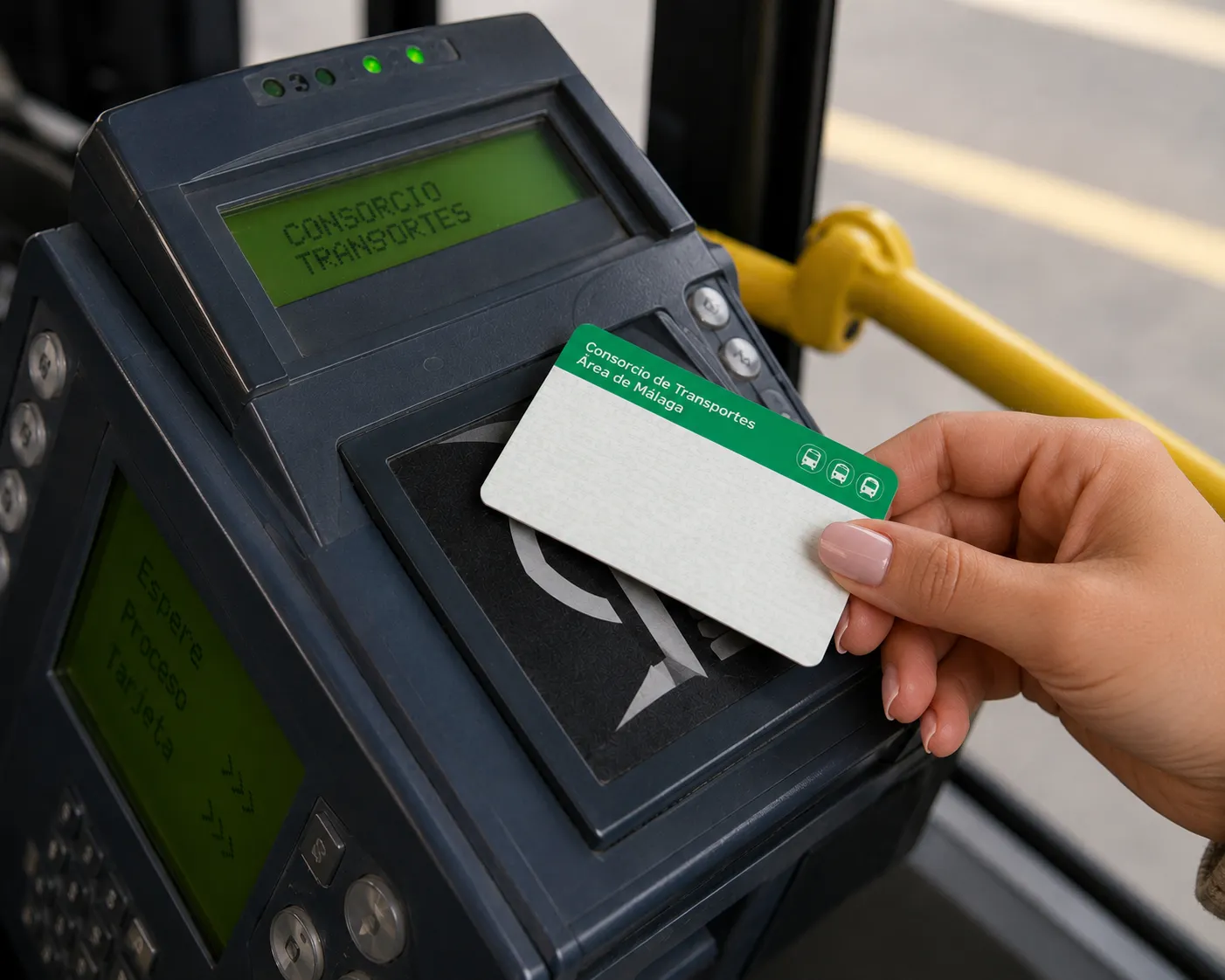
The Green ‘Consorcio’ Card Explained
Affiliate disclosure: This article contains affiliate links. If you click through and make a purchase, Stafford Affiliates Travel may earn a commission at no extra cost to you.
If you are planning to use buses, the Malaga Metro or local trains on the Costa del Sol, the green Consorcio card, officially called the tarjeta de transporte del Consorcio, can be one of the most useful things to sort out early in your trip.
It is not a tourist pass, and it is not an unlimited travel card. It is a rechargeable pay-as-you-go public transport card that gives access to reduced Consorcio fares on participating services.
For visitors staying in places such as Benalmádena, Torremolinos, Fuengirola, Málaga city or elsewhere along the Costa del Sol, it can make local travel cheaper and easier. However, it is only useful if you understand where to buy it, where it works, how to validate it properly, and where it will not be accepted.
Quick answer: the green Consorcio card is usually worth having if you will make several local bus, Metro or Cercanías train journeys around Málaga and the Costa del Sol. It costs €1.50 for the card itself, with a minimum initial recharge of €5 at many official points, so expect to pay at least €6.50 to get started. Take cash, especially if buying from an estanco or small sales point.
What the green Consorcio card actually is
The green Consorcio card is a rechargeable transport wallet card. You load money onto it, then use that balance to pay for journeys on participating public transport services.
Instead of buying a separate ticket each time, you validate the card when you travel. The appropriate fare is then deducted from the balance on the card.
The important point is that the card is not a fixed-price tourist pass. It does not give unlimited travel for a day, a week or a holiday. Your balance reduces each time you use it.
The card can still be very useful because Consorcio fares are often cheaper than ordinary single fares. It also means you are not constantly looking for cash, ticket machines or the correct fare before every journey.
Where to buy the green Consorcio card
The card is sold at official Consorcio points of sale. These include many estancos, which are Spanish tobacconists, plus some kiosks, transport ticket offices and Consorcio sales points.
In Málaga city, useful places to know about include Málaga bus station at Paseo de los Tilos, the Muelle de Heredia bus area, and the Consorcio office area around Avenida Manuel Agustín Heredia. Some Renfe Cercanías ticket offices can also sell the card.
In resort areas such as Benalmádena, Torremolinos and Fuengirola, many visitors try local estancos first. This can work well, but it is not always as smooth as online advice makes it sound.
Some estancos may not have cards in stock. Others may be able to recharge a card but not issue a new one, or the staff member on duty may not be confident with the process. If the first tabac or estanco cannot help, try another official point of sale rather than assuming the card is unavailable.
A practical approach is to search for “puntos de venta Consorcio Málaga” before you travel, then note two or three possible places near your hotel, bus station or first planned route.
Can you buy it at Málaga Airport?
This is one of the areas that catches visitors out. Málaga Airport is well connected by bus and train, but buying the green Consorcio card immediately on arrival is not always as straightforward as people expect.
There is a bus ticket office near the arrivals exit area at Málaga Airport. It is useful if you are taking a coach or need help with bus tickets, especially for longer-distance services such as routes towards Marbella, Estepona or other destinations.
However, do not build your whole arrival plan around the assumption that this airport ticket office will definitely sell or recharge the green Consorcio card on the day you arrive. Opening times, staffing, card availability and the exact service offered can vary.
If you are landing tired, late, or with luggage and children, the simplest option may be to pay for your first journey separately, then buy the card later at Málaga bus station, a Renfe ticket office, a Consorcio point or an estanco near your accommodation.
If you are arriving during normal hours and the airport ticket office is open, it is still worth asking. Just have a backup plan.
How much the card costs and the minimum top-up
The standard management charge for buying the green Consorcio transport card is €1.50. This is the cost of the physical card and setup.
You then need to add travel credit. The minimum initial recharge commonly shown by the Consorcio is €5, which means the starting cost is usually at least €6.50 in total.
That €6.50 is not all a fee. The €1.50 is the card charge, while the €5 becomes travel balance that you can use for journeys.
You can top up the card again when the balance gets low. On a short holiday, €5 or €10 may be enough depending on how often you travel. For a longer stay, you may prefer to add more, but do not overload the card unless you are confident you will use the balance.
Why you should take cash
When buying or topping up the card, take cash.
Some places may accept card payment for other purchases but still want cash for Consorcio card transactions.
To avoid wasting time, take small euro notes with you. If you want to buy the card and add the minimum starting credit, have at least €6.50 available in cash. In practice, taking €10 or €20 gives you more flexibility.
This matters most if you are arriving at the start of a trip and want to get moving quickly. A card that is theoretically available but cannot be paid for in the way you expected is not much use when you are standing there with luggage.
Where the card can be used
The green Consorcio card can be used on a wide range of participating public transport services in the Málaga area and wider Andalusian Consorcio network.
In and around the Costa del Sol, the most useful services for visitors are usually:
- Consorcio interurban buses in the Málaga metropolitan transport area.
- Urban buses in Málaga city where the Consorcio card is accepted.
- Urban buses in places including Benalmádena, Torremolinos, Rincón de la Victoria and Alhaurín de la Torre where included.
- Málaga Metro.
- Renfe Cercanías Málaga lines C-1 and C-2.
The C-1 Cercanías line is particularly useful for many visitors because it links Málaga, Málaga Airport, Torremolinos, Benalmádena, Fuengirola and intermediate stops.
The C-2 line is useful for travel between Málaga and places towards Álora. If you are using the card on either line, remember that the train rules are stricter than bus rules because you must validate at both the start and the end of the journey.
The card can also be used on some other Andalusian Consorcio systems, including certain metro and Cercanías networks outside Málaga, but most holiday visitors will mainly use it locally.
Where the card will not be accepted
The green Consorcio card is useful, but it is not universal. Do not assume it works on every form of transport just because you are still in Málaga province or on the Costa del Sol.
- Taxis.
- Private airport transfers.
- Hire cars.
- Long-distance coaches that are not part of the Consorcio fare system.
- AVE, long-distance Renfe trains or high-speed rail services.
- Tourist buses.
- Sightseeing buses.
- Private excursion coaches.
- Boat trips.
- Cable cars.
- Attractions.
- Museum entry.
It may also not be valid on some specific bus routes, special services or ticket types. If your journey depends on one exact route, check that route before relying on the card.
For example, a local Consorcio bus and a long-distance coach may both leave from a transport hub, but that does not mean they use the same ticket system.
How to use the card on buses
On buses, you normally board at the front and present the card to the driver or place it on the card reader near the driver.
If the route has different fare zones, tell the driver where you are going before validating. The driver needs to know the destination so the correct fare can be charged.
Wait for confirmation before moving down the bus. If you are unsure whether the card has registered, ask the driver immediately rather than sitting down and hoping it worked.
On most bus journeys, you validate when boarding. You do not normally tap out when leaving the bus. This is different from using the card on Cercanías trains, where tapping out is essential.
If more than one person is travelling on the same non-personalised card, ask locally before relying on this. Rules can vary by system and by mode of transport, and personalised cards with a photograph are for the named holder only.
How to use the card on Cercanías trains
On Renfe Cercanías trains, the card must be validated at the start and at the end of your journey.
At stations with barriers, tap the card at the gate when entering. At your destination, tap it again at the exit gate so the system can calculate and close the journey properly.
The fare may initially be treated as a basic fare when you enter, then adjusted when you leave. That is why the exit validation matters.
If you forget to tap out, the system may not know where your journey ended. That can lead to a higher charge or a penalty situation.
This is one of the biggest differences between using the card on buses and using it on trains. On a bus, you normally validate when boarding. On Cercanías, think “tap in and tap out”.
What to do at railway stations with no barriers
Some Cercanías stations are open stations with no physical barriers. This does not mean you can skip validation.
If there are no gates, look for the small card validator machine. It may be near the station entrance, by the platform access point, close to the ticket machines, or positioned where passengers walk onto the platform.
You must use the validator before boarding and again when you leave at your destination, even if the station is open and nobody is checking tickets at that moment.
This is especially important at smaller stops where it can feel informal. The lack of a barrier does not remove the need to validate the card.
If you cannot immediately see the validator, do not rush straight to the platform. Take a moment to look around the entrance area, ticket-machine area and platform access route.
What happens if you do not tap out
Failing to tap out on Cercanías can cause problems. The system needs the exit validation to close the journey and calculate the correct fare.
If the journey is not completed correctly within the permitted time, you may be treated as travelling without a valid ticket. The Consorcio information also warns that the system may apply the maximum journey calculation in some cases.
For visitors, the simple rule is this: every time you use the green card on Cercanías, tap in before boarding and tap out when you leave, even at open stations.
If something goes wrong, such as a validator not working or a gate refusing the card, speak to station staff where available. Do not just walk away without trying to resolve it.
When the card is worth it
The card is usually worth considering if you will use public transport several times during your stay.
It can be especially useful if you are staying in Benalmádena, Torremolinos or Fuengirola and plan to use the C-1 train line, local buses or trips into Málaga city.
It is also useful if your trip combines airport travel, resort travel and day trips. For example, you might use public transport from the airport, visit Málaga city, travel along the coast, and make local trips from your accommodation.
Even when the saving per journey is modest, the convenience can be worth it. You avoid repeatedly buying tickets and reduce the risk of being caught out by cash-only moments.
For budget-conscious travellers, families, couples and longer-stay visitors, the savings can add up over several journeys.
When it may not be worth it
The card may not be worth the effort if you are only making one or two public transport journeys.
If you have a private airport transfer, plan to use taxis, or will spend most of your stay within walking distance of your accommodation, you may not use the card enough to justify buying it.
It may also be less useful if your main journeys are on long-distance coaches, private excursions or services outside the Consorcio system.
For a very short break, the simplest option may be to buy single tickets as needed. The card makes most sense when you will use the local network repeatedly.
Common mistakes to avoid
Assuming it is a tourist pass
The green Consorcio card is not unlimited. It is a rechargeable wallet card, so each journey uses part of your balance.
Assuming every transport service accepts it
The card works on participating services, not every bus, train or coach in the region. Always check specific routes if your plan depends on one service.
Forgetting that some sales points may be awkward
Estancos are useful, but not every Tabasco will be able to sell a new card at the exact moment you arrive. Have a backup location in mind.
Not carrying cash
Take cash when buying or topping up the card, this avoids a frustrating wasted trip.
Not tapping out on Cercanías
This is the mistake most likely to cause avoidable problems. On trains, always tap in and tap out, even at stations with no barriers.
Walking past the small validator at an open station
If there are no gates, look for the card reader. Open station does not mean no validation.
The practical bottom line
The green Consorcio card can be a very useful travel tool on the Costa del Sol, especially if you are using buses, Málaga Metro and Cercanías trains more than once or twice.
It is cheap to get started, with a small card charge and a minimum starting balance, but you need to know the practical details. Buy it from an official sales point, take cash, allow for the possibility that some estancos may not be able to help, and do not rely entirely on getting it at the airport unless you have confirmed it on arrival.
Once you have the card, use it correctly. On buses, validate when boarding and tell the driver your destination if needed. On Cercanías trains, tap in and tap out every time, including at stations without barriers.
If your Costa del Sol trip includes regular public transport, the card can save money and reduce hassle. If you are only making one or two journeys, single tickets may be simpler.
The best approach is to match the card to your actual travel plans, not just buy it because other travellers mention it. Used properly, it is one of the simplest ways to make independent travel around Málaga and the Costa del Sol smoother.