
How to Book Louvre Tickets Without Mistakes
Affiliate disclosure: This article contains affiliate links. If you click through and make a purchase, Stafford Affiliates Travel may earn a commission at no extra cost to you.
If you leave Louvre tickets until the night before, you may still get in – but not necessarily at a sensible time, through your preferred entrance, or at a price that makes sense. For most travellers, how to book Louvre tickets comes down to one thing: reserving the right timed entry early enough that the visit fits the rest of the day instead of taking it over.
The Louvre is not a place to treat casually if your trip is short. It is one of those attractions where a small booking mistake can create a long queue, a rushed visit, or an expensive last-minute workaround. The good news is that booking is straightforward once you know what you are choosing and why.
How to book Louvre tickets step by step
The basic process is simple. First, decide the date you want to visit and whether you prefer a morning, midday or later afternoon slot. Then choose the type of ticket that matches your group, complete the booking, and keep the confirmation somewhere easy to access offline in case your mobile signal or battery lets you down.
The most important part is the timed entry slot. This is not just a formality. Your entry time affects queue length, crowd levels inside, and how much of your day remains afterwards. If you are building a tight city-break itinerary, that matters more than people expect.
Morning slots usually suit travellers who want the museum to be the main event of the day. You are fresher, you have more time inside, and you are less likely to start cutting galleries because lunch or evening plans are approaching. Later slots can work well if you are not aiming to see everything and would rather visit after the initial rush, but they are less forgiving if you are delayed.
When booking, read the ticket wording carefully. Standard admission is enough for most people. You do not need to overcomplicate it with extras unless you genuinely want a guided experience or a combined product that saves time elsewhere. A lot depends on your travel style. If you prefer structure and context, a guided option can be useful. If you are comfortable navigating alone, standard timed entry is usually the cleaner choice.
Which Louvre ticket should you choose?
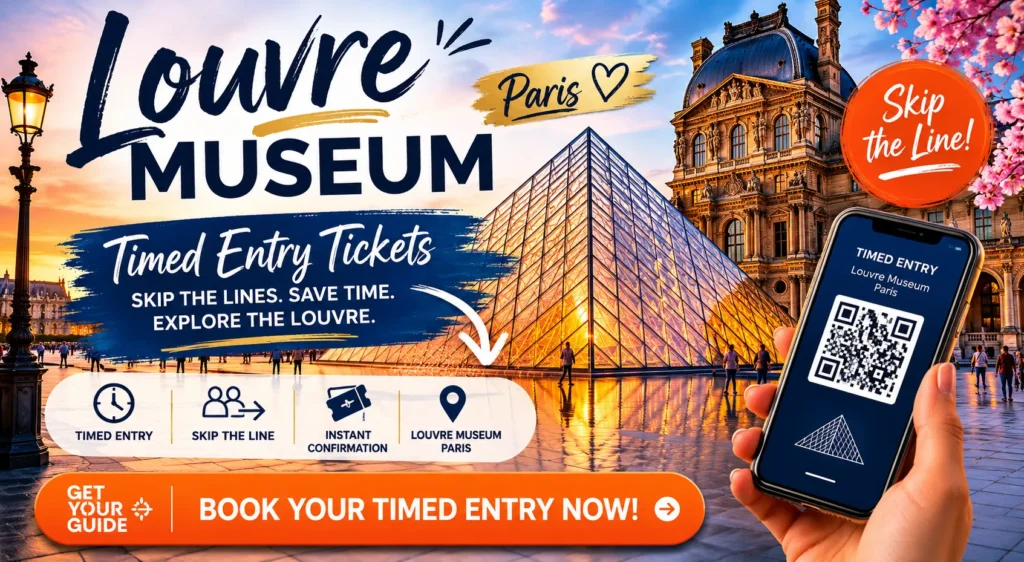
For most independent travellers, the decision sits between standard timed entry and a guided or hosted entry product. Standard timed entry is normally the best-value option if you are happy to plan your own route and understand that one visit will only cover a fraction of the collection.
A guided ticket can make sense if this is your first visit, if you have limited time, or if you know you will get overwhelmed by the size of the museum. The trade-off is less flexibility. You are following somebody else’s pace, and that can feel restrictive if you prefer to linger in certain rooms and skip others quickly.
Families often need to think less about ticket type and more about timing. A theoretically ideal ticket is not very useful if it lands in the middle of nap time, lunch, or the part of the day when children have run out of patience. In practice, a shorter, better-timed visit is usually more successful than a long, ambitious one.
If you qualify for free or reduced entry under the museum’s rules, still check whether you need to reserve a time slot. This is where people get caught out. Eligibility does not always mean you can simply turn up without planning.
When to book Louvre tickets
If the Louvre is a priority for your trip, book as soon as your travel dates are fixed. That does not mean months in advance in every case, but waiting rarely improves your options. Popular days and stronger time slots can fill first, especially in busier travel periods and around school holidays.
If your plans are still slightly fluid, think in terms of risk. Booking early gives you the best choice of entry times, but it also means committing sooner. Leaving it late gives you more flexibility before booking, but less flexibility once the remaining slots are poor. There is no perfect answer here. It depends on how fixed the rest of your itinerary is and how disappointed you would be to miss the museum altogether.
As a rule, if you only have a few days away, it is worth treating the Louvre as an advance-book item rather than a same-week decision.
Common mistakes when booking Louvre tickets
The biggest mistake is assuming all tickets offer the same experience. They do not. Some include only admission, while others include hosting, guiding, or bundled services that may or may not justify the price difference for you.
The second mistake is choosing a time slot without thinking about travel time to the museum. This sounds obvious, yet it causes real problems. If you are arriving by train that morning, changing hotels, or relying on unfamiliar public transport, build in more buffer than you think you need. Timed entry attractions are rarely the place to test a best-case schedule.
Another common error is overestimating how much you can comfortably see. The Louvre is vast. Trying to cover everything in one visit usually leaves people tired and oddly unsatisfied. A better approach is to accept that you will prioritise. Book the slot, then choose a rough route based on the works or sections that matter most to you.
The final mistake is not checking the ticket conditions after booking. Look at the date, time, number of visitors, and any age-related requirements straight away. It is much easier to correct an error immediately than once you are already travelling.
How to plan the visit after you book
Once your booking is confirmed, the next job is not more booking – it is trimming the visit down to a realistic shape. Decide in advance whether you want a highlights-led visit or a broader wander with a few anchor points. Both can work, but mixing them badly often leads to doubling back and unnecessary fatigue.
Aim to arrive early rather than exactly on time. Security and queue management can still take time, even with a reserved slot. Keep your ticket accessible, charge your mobile phone properly, and if possible save a screenshot as well as the email confirmation. It is a small habit that prevents a lot of avoidable stress.
Footwear matters more than most museum guides admit. This is a long walking visit on hard floors, often with plenty of standing. If your wider trip includes a lot of city walking, pace yourself. The smartest travellers do not try to prove endurance inside museums.
If you are carrying luggage on a travel day, do not assume that is a good museum day. Even if storage is available elsewhere, dragging bags across a tightly scheduled day usually makes the visit feel like an obligation. If you can, place your Louvre booking on a more settled day.
Is it better to book direct or through a third party?
If you are wondering how to book Louvre tickets in the simplest way, booking direct is often the clearest option for standard admission. It usually gives you the cleanest pricing structure and the most direct ticket information.
That said, third-party sellers can still be useful in some cases. If standard admission is unavailable for your preferred time, or if you specifically want a guided experience, a reputable booking platform may offer alternatives that fit better. The trade-off is that prices can be higher and the product details need more careful reading.
The practical rule is this: compare what is actually included, not just the headline price. A slightly higher price may be fair if it includes something you genuinely need. It is poor value if it only repackages the same entry with extra friction.
A good Louvre booking does not just secure entry. It protects your time, your energy and the shape of your whole day. Book the slot that fits how you actually travel, not how you imagine an ideal museum day should look.