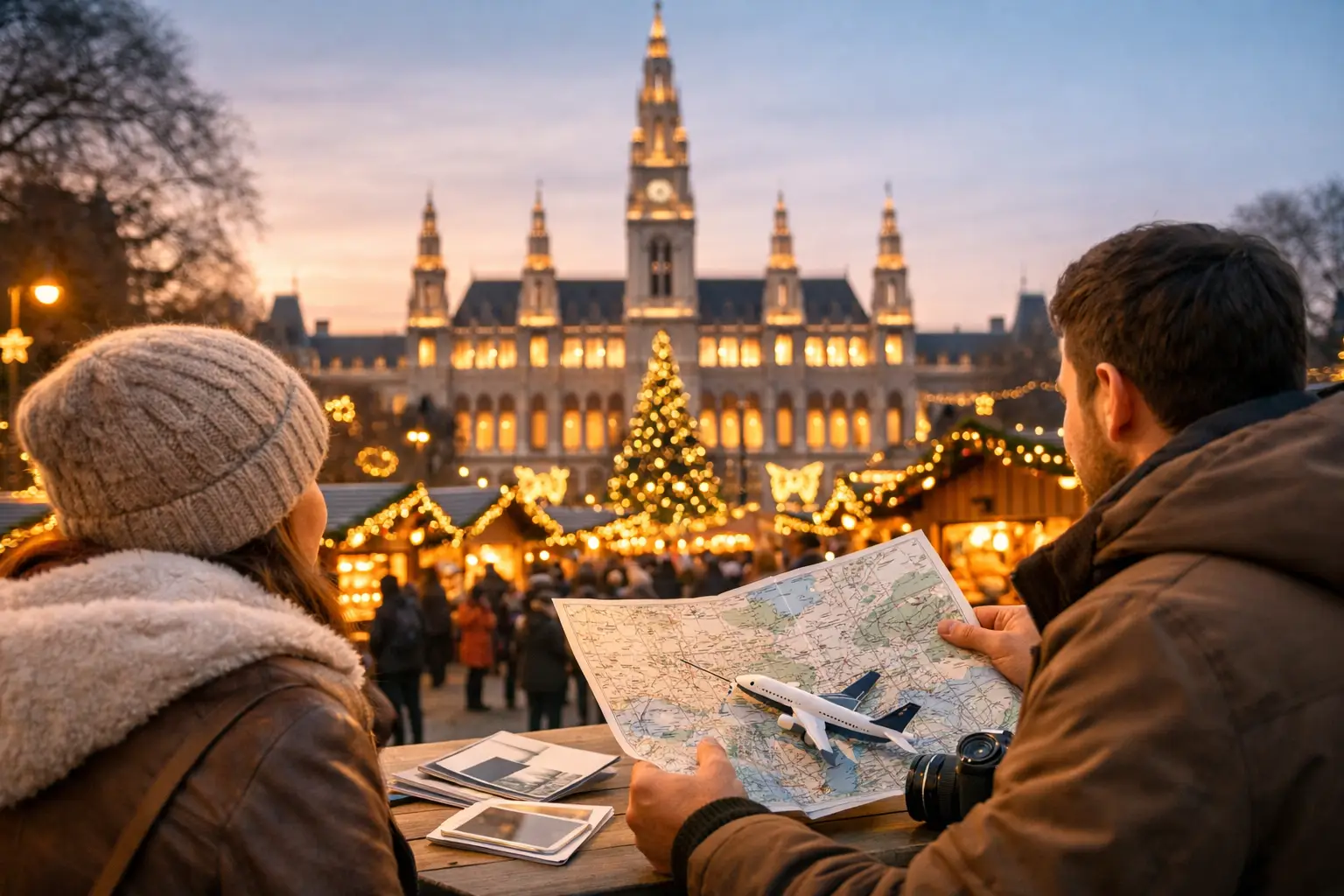
Vienna Christmas Market Planning for 3 Days
Vienna Christmas market planning works best when you treat the city as a set of neighbourhoods rather than trying to visit every stall in one weekend. The markets are spread across grand squares, palace grounds and smaller residential streets, but Vienna’s trams and U-Bahn make a focused three-day break very manageable. Book the essentials early, keep each day to two main market areas, and leave room for a warm indoor stop when the temperature drops.
Start Vienna Christmas market planning with the right dates
Vienna’s main festive markets usually run from mid-November to late December, although dates, closing times and the final day of trading differ by location each year. Some sites continue in a New Year format after Christmas, while others close before 24 December. Check the current opening dates for each market before paying for flights or accommodation, especially if you are travelling in the final week before Christmas.
For a first visit, late November or the first two weeks of December are often the best balance. The decorations are in place, the largest markets are open, and hotel prices can be more reasonable than they are during the last pre-Christmas weekend. Weekday afternoons are considerably calmer than Friday and Saturday evenings. Families with younger children may find an early start more comfortable, while couples and groups looking for the full atmosphere may prefer to arrive at dusk, when the lights are at their best.
A three-night stay is the practical minimum. It gives you two full days plus an arrival or departure day, without turning a short city break into a rush between markets. Four nights is worth considering if you want to include museums, a concert or a day trip as well as festive sightseeing.
Choose an area to stay that saves time
Where you stay affects how much of Vienna you can enjoy on foot. The Innere Stadt, or first district, is the most central choice for a short break. It puts you close to St Stephen’s Cathedral, the markets around the historic centre and several U-Bahn connections. The trade-off is higher room rates and a busier atmosphere.
For better value without losing convenience, look at accommodation around Neubau and the MuseumsQuartier. This area is well placed for the Spittelberg market, cafés and tram connections, and it feels less formal than the first district. Leopoldstadt can suit families or travellers arriving through Praterstern, with generally larger hotel options and quick access to the centre by U-Bahn.
Schönbrunn is appealing if the palace market is your priority, but it is not the best base for a first three-day visit unless you are happy using public transport every evening. Staying near a U-Bahn station matters more than being close to one individual market. In winter, a ten-minute walk can feel much longer after several hours outside.
When booking, check whether breakfast is included and whether the hotel offers a kettle or hot drinks station. These small details can reduce morning spending and give you a useful warm-up before heading out.
A realistic three-day Vienna Christmas market route
Day one: the historic centre and Rathausplatz
After checking in, start with a gentle walk around the first district. St Stephen’s Cathedral, Graben and Kärntner Strasse provide the classic central Vienna setting, with plenty of places to stop if the weather is wet. Do not try to cover every nearby market on your first afternoon. Pick one for food and one for browsing.
Make Rathausplatz your main evening stop. The large market in front of City Hall is the best-known choice and is popular for its scale, seasonal lighting and family-friendly activities. It is also one of the busiest. Arrive before the evening peak if possible, walk the outer stalls first, then decide where to eat rather than queueing at the first stand you see.
Day two: Schönbrunn and Spittelberg
Visit Schönbrunn Palace in the morning or early afternoon. The market’s palace setting gives it a more formal feel than the central sites, and the wider layout can be easier to navigate than Rathausplatz. If you intend to tour the palace, reserve your preferred entry time in advance. Market access itself is typically free, but attractions nearby may not be.
In the evening, travel to Spittelberg. Its market occupies narrow streets lined with small shops and is often a better choice for handmade gifts, ceramics and independent traders. The lanes can still become crowded, so it is less suitable for pushchairs at the busiest times. This is a good night to eat at a proper restaurant rather than relying entirely on market snacks, particularly if your group has dietary requirements.
Day three: Karlsplatz, Belvedere and a flexible finish
Use your final full day for Karlsplatz and the area around Belvedere Palace. Karlsplatz is commonly associated with more craft-led stalls and can feel less repetitive if you have already visited the larger markets. Belvedere offers another elegant setting and combines well with a museum visit if conditions are cold or rainy.
Keep your last evening flexible. Return to your favourite market for a final drink, book a concert if that is a priority, or have a quieter meal close to your hotel. A planned free evening is useful because winter travel can be affected by delayed flights, tired children or simply the need to get out of the cold.
Get around without overspending
Vienna’s public transport is usually the simplest way to move between markets. The U-Bahn is fast for longer hops, while trams are useful for sightseeing because you can see more of the city on the journey. Buy the ticket or travel pass that matches your actual plans rather than automatically choosing the longest option. If you are mostly walking in the centre and only using transport twice a day, individual tickets may be better value. A short-duration pass can make more sense if you are changing neighbourhoods frequently.
From Vienna Airport, compare the airport rail options before you travel. The dedicated express service is quick and straightforward, but usually costs more. Regular S-Bahn and rail services can offer better value, depending on where your accommodation is located. Check the final station, your onward connection and the luggage walk before deciding. The cheapest route is not always worthwhile after an evening flight with children or heavy cases.
Taxis and ride-hailing can be helpful for a very early departure, but they are rarely necessary for moving around the centre. Build in time for public transport and avoid trying to cross the city at peak market hours.
What to book before you leave
Christmas markets do not normally require tickets, but Vienna is busy in the festive season and the surrounding trip needs planning. Prioritise flights, accommodation and airport transfers first. Then consider timed palace entry, concerts, popular restaurants and any special experience that would disappoint you to miss.
Before departure, make sure each traveller’s passport meets Austria’s current entry requirements and check the latest rules for UK visitors. Take travel insurance details, download transport information for offline use, and keep your hotel address saved in your phone and written down separately.
Carry a payment card, but do not rely on it alone. Most larger stalls accept contactless payment, yet a small amount of euros is useful for tips, smaller traders and public toilets. Set a daily food and gift budget before you arrive. Market spending adds up quickly when every stop involves a hot drink and a snack.
Lower-waste choices that still feel practical
Vienna’s markets commonly use deposit cups for hot drinks. Pay the deposit, keep the cup while you finish your drink, then return it to a participating stall to get the money back. Taking several souvenir cups home can be tempting, but only keep one if you genuinely plan to use it. Returning the rest reduces the items you need to pack and helps the cup system work as intended.
Bring a refillable bottle for your room and day bag, plus a lightweight reusable shopping bag for gifts. Choose durable items made locally where possible instead of novelty products that are likely to be discarded after the holiday. If you buy food to take away, ask for only the cutlery and napkins you need.
Dress for standing outdoors rather than just walking between attractions. Waterproof shoes with grip, warm socks, layers, gloves and a hat will do more for your enjoyment than trying to fit in another market. Vienna rewards a slower approach: pick a few places, linger over the ones you like, and leave with a plan that still feels like a holiday.