
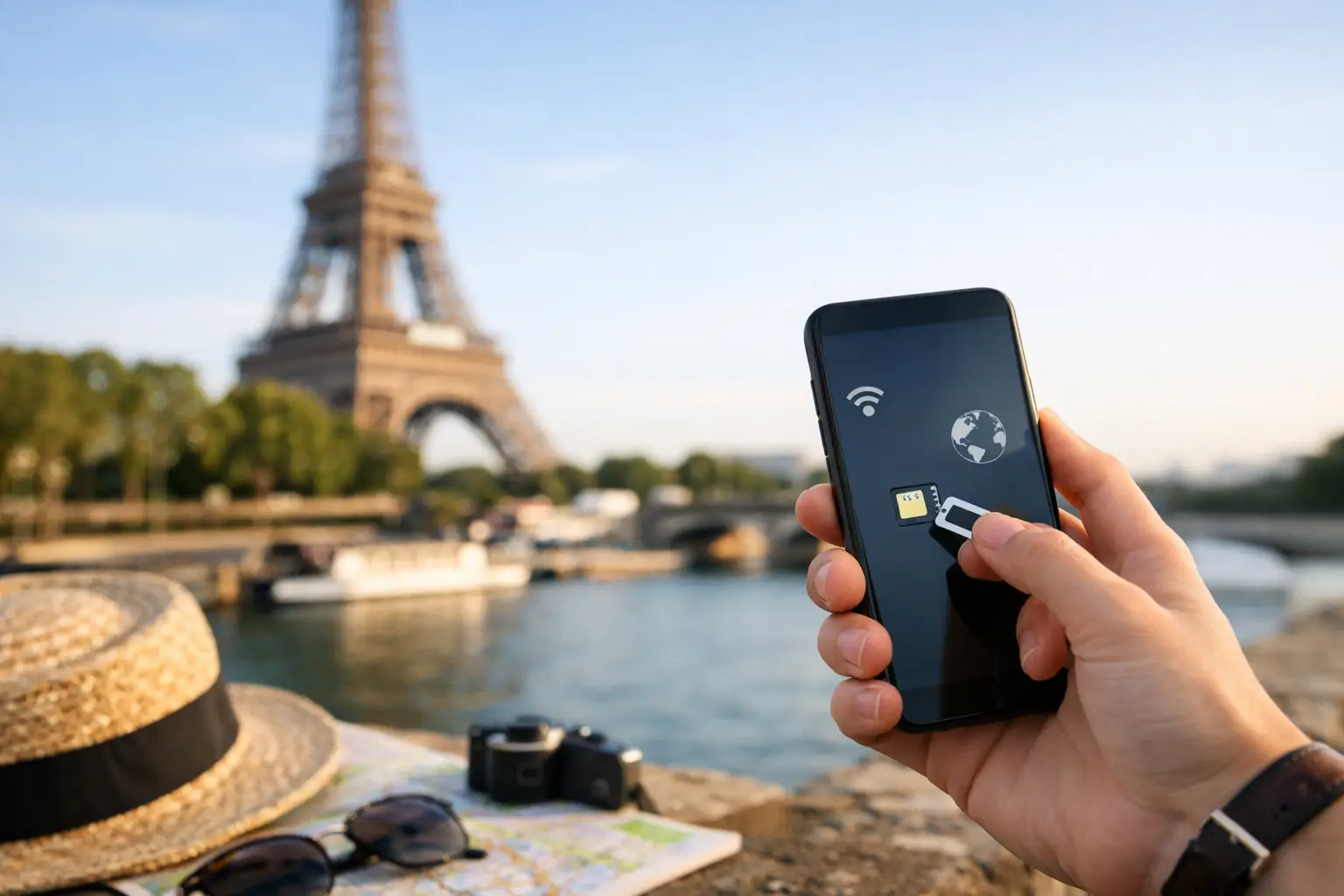
Best eSIM for Paris (2026): UK Traveller Guide
You land at Charles de Gaulle, switch off flight mode, and suddenly every next step depends on your phone. Train tickets, hotel check-in details, maps, banking alerts, museum bookings, taxi apps – they all work better when you are connected straight away. That is why choosing the right Paris eSIM for tourists is less about tech and more about removing friction from the first hour of your trip.
For most UK travellers, an eSIM is the simplest way to get mobile data in Paris without hunting for a physical SIM card or risking expensive roaming charges. But not every eSIM is a good fit. The cheapest option is not always the most reliable, and the biggest data plan is often unnecessary for a city break. What matters is whether it matches the way you travel.
Why a Paris eSIM for tourists makes sense
Paris is an easy city to navigate once your phone is working properly. Google Maps or Citymapper can get you onto the right Metro platform, digital attraction tickets save queueing, and messaging apps make it easier to coordinate with family or travelling companions. If your connection is patchy, those small tasks become avoidable stress.
An eSIM works by letting you activate a mobile plan digitally on a compatible phone. There is no need to swap out your UK SIM, which is useful if you still want to receive texts or keep your usual number active for banking verification. For short breaks, that convenience is often the main selling point.
It also suits lower-waste travel habits better than buying a plastic SIM for a few days and discarding it at the end of the trip. It is a small difference, but for travellers trying to pack lighter and waste less, it is a sensible option.
What to look for in the best Paris eSIM for tourists
The right plan depends on trip length, phone use, and whether Paris is your only stop. A couple visiting for two nights will need something different from a family doing Paris plus Belgium and the Netherlands over ten days.
Coverage matters more than headline data
In central Paris, coverage is usually strong across major networks. The more useful question is how the provider performs in the places where travellers actually notice weak service – underground Metro stations, busy transport hubs, and outer neighbourhoods. A plan with generous data is less helpful if the connection feels unreliable when you are trying to find the correct RER train.
Most travellers do well with a provider that uses established French networks. If the eSIM brand is vague about which network it runs on, that is worth pausing over.
Choose data based on how you actually use your phone
For a typical long weekend in Paris, 3GB to 5GB is often enough if you are using maps, browsing, messaging, and some social media. If you upload lots of video, tether to a laptop, or stream heavily on the move, you will need more. Families using one person as a hotspot can burn through data surprisingly quickly.

Stay Connected in Paris for Less
Airalo offers affordable eSIM data plans with reliable coverage across France and Europe. It is ideal for travellers who want fast, simple connectivity without the hassle of swapping physical SIM cards.

Stay Connected Anywhere with Flexible eSIM Plans
Yesim offers flexible eSIM data plans with reliable coverage across France and over 200 countries worldwide. It is a great option for travellers who want the freedom to stay connected across multiple destinations without changing SIMs or worrying about roaming charges.

Get Online in Seconds with Simple eSIM Setup
Saily offers a fast and straightforward way to get online in Paris with no app required and instant activation. It is ideal for travellers who want a simple, reliable connection without technical setup, making it perfect for quick trips and hassle-free travel.
Check the validity period carefully
A seven-day plan can be excellent value if you are in Paris for five days. It is less useful if activation starts at purchase rather than first use, or if your wider trip runs longer than expected. This catches people out on multi-stop holidays.
If Paris is one stop on a longer European trip, a regional eSIM may be better than buying a France-only plan. It can save you from installing one plan for Paris and another when you cross a border.
Calls and texts are usually not the priority
Many travel eSIMs are data-only. For most tourists, that is absolutely fine. WhatsApp, FaceTime, iMessage and other internet-based apps cover nearly everything. If you specifically need a local number for restaurant bookings or business calls, you will need to filter options more carefully.
For the average leisure traveller, data reliability matters far more than traditional call minutes.
Common mistakes travellers make
The most common issue is assuming every modern phone supports eSIM. Many do, but not all. Before you buy anything, confirm that your handset is eSIM-compatible and unlocked. If your phone is tied to a network, the eSIM may not work at all.
Another mistake is leaving setup until arrival. Paris airports and stations are not the best place to troubleshoot QR codes, activation errors, or weak terminal Wi-Fi after a journey. It is usually better to buy before you travel, install in advance, and only switch the plan on when needed.
There is also a tendency to overbuy data. For a city break where your hotel, café stops and some attractions have Wi-Fi, huge data bundles are often unnecessary. Paying for 20GB when you will use 4GB is not smart planning – it is just easy marketing to fall for.
How to set up your eSIM before flying
The setup process is usually straightforward, but timing matters. Buy the plan once your dates are fixed, then install it at home while you have stable Wi-Fi and enough time to follow the instructions properly.
Most providers will give you a QR code or manual activation details. Once installed, label the eSIM clearly in your settings so you do not confuse it with your UK line. On iPhone or Android, you can usually choose which SIM handles data and which handles calls.
Before departure, turn off data roaming on your primary UK SIM unless you specifically want to use it. That reduces the risk of accidental charges. Then, when you land in Paris, switch mobile data to the travel eSIM and check that data roaming is enabled for that eSIM if the provider requires it.
It is also worth downloading a few essentials before you travel: offline maps for Paris, hotel details, train or flight confirmations, and screenshots of key bookings. Even a good eSIM can take a few minutes to connect after landing, and having backups keeps things moving.
How much data do you need in Paris?
For most travellers, usage is lower than expected unless they stream heavily. If you are in Paris for three to four days and mostly using maps, web browsing, messaging, and ticket apps, 3GB to 5GB should be comfortable. If you are there for a week, 5GB to 10GB gives more breathing room.
You may need more if you rely on hotspotting for children’s devices, upload lots of video to Instagram or TikTok, or use cloud-based work apps while away. On the other hand, if you are disciplined about hotel Wi-Fi and keep media uploads for later, you can manage with less.
A sensible middle ground is often better than chasing the absolute cheapest or the largest plan.
Is an eSIM better than roaming from the UK?
It depends on your mobile network and your plan. Some UK contracts include EU roaming or offer bolt-ons that make short trips easy. If your network gives you low-cost roaming in France with enough data, that may be the simplest route.
But many travellers now face daily roaming charges, reduced allowances, or confusing fair-use rules. In that case, an eSIM is often clearer and easier to control. You know what you have bought, when it expires, and what it covers.
The main trade-off is that travel eSIMs can be less flexible for traditional calls and texts. If your priority is affordable mobile data for navigation and bookings, they are usually a strong option. If you need your normal mobile usage exactly as it works at home, roaming may still suit you better.
A practical choice for most Paris trips
For a short Paris break, the best eSIM is usually one with reliable French network access, a realistic amount of data, and an activation process you can complete before leaving the UK. That may sound basic, but those are the details that make the difference when you are trying to get from the airport to your hotel without wasting time.
Stafford Affiliates Travel generally recommends keeping your setup simple. Buy only what you are likely to use, install it before travel, and make sure your phone is compatible well in advance. That approach is less glamorous than chasing a headline deal, but it is usually the one that works.
If you treat connectivity as part of your transport planning rather than an afterthought, Paris becomes easier from the moment you arrive. And on a short city break, that saved time is often worth more than squeezing out the absolute lowest price.