
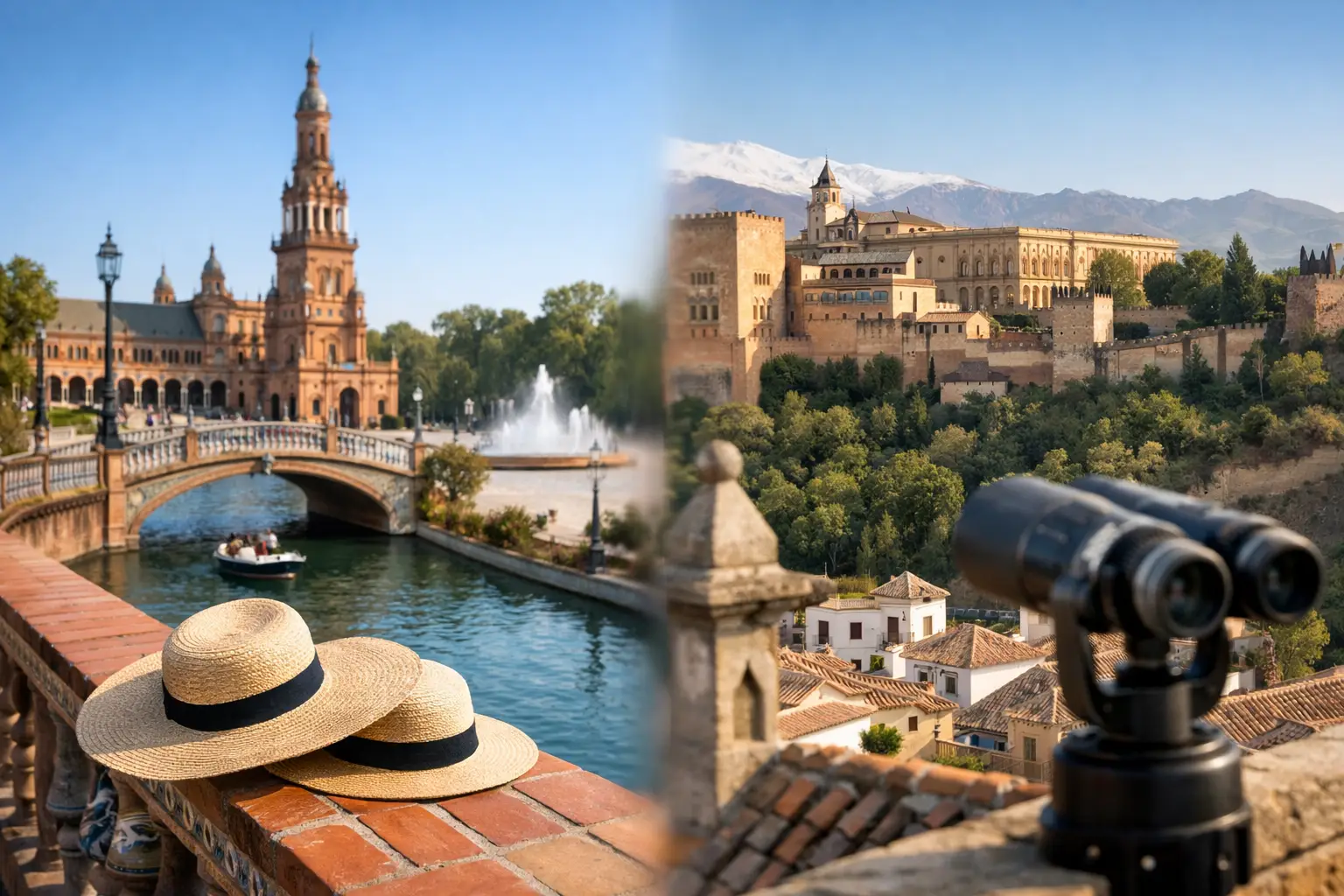
Seville or Granada Stay: Pick the Right City
A Seville or Granada stay comes down to the pace you want from your holiday. Seville is the stronger choice for a first Andalusian city break with restaurants, major sights and straightforward transport close at hand. Granada is smaller, hillier and more atmospheric, with the Alhambra as its defining experience and the Sierra Nevada within easy reach.
For many UK travellers, the best answer is not which city is objectively better, but which one makes the rest of the trip simpler. A long weekend, a family break and a rail-based itinerary all produce different answers.
Seville or Granada stay: quick answer
Stay in Seville if you want a lively city base, a broad choice of accommodation, easy walking between headline sights and better connections for an onward trip. It suits travellers who like having a full itinerary without relying heavily on taxis or buses.
Stay in Granada if the Alhambra is a priority, you prefer a more compact old city and you are happy with slopes, cobbled streets and a slightly slower rhythm. It is particularly good for couples, culture-focused travellers and anyone combining city time with mountain scenery.
If you have six nights or more, split the trip. Three nights in each city avoids a rushed visit and gives you a more rounded view of southern Spain. With only two or three nights, choose one base rather than spending valuable time changing hotels.
Compare the practical differences before booking
| Factor | Seville | Granada | |—|—|—| | Best for | First visits, food, city energy, rail connections | The Alhambra, historic lanes, views and a quieter break | | Ideal stay | 3 to 4 nights | 2 to 3 nights | | Walking | Mostly flat, though summer heat is demanding | Compact but noticeably hilly | | Transport | Strong rail links and a well-connected airport | Good rail and coach options, but fewer direct flight choices | | Accommodation | More choice across a wider range of areas | Often better value, but check access on steep old-town streets | | Day trips | Córdoba, Cádiz, Jerez and smaller Andalusian towns | Sierra Nevada, Las Alpujarras and nearby villages |
Neither city is a bargain at peak times. Prices rise around Easter, major events, school holidays and popular weekends. Seville generally has more rooms, but demand can be intense. Granada can look cheaper until you factor in taxis for a property with difficult luggage access or a location far from the centre.
Choose Seville for a fuller city-break itinerary
Seville is built for travellers who want to see a lot without turning the trip into a transport project. The cathedral, Real Alcázar, Santa Cruz, Plaza de España and the riverside are close enough to organise into sensible walking days. There is plenty to do after the headline sights too, from neighbourhood bars to flamenco venues and markets.
The city works well for a long weekend because it offers choice. You can spend one day on historic monuments, one around parks and neighbourhoods, then leave room for a relaxed meal or an evening performance. Families may find this flexibility useful, especially when sightseeing needs to be broken up.
For where to stay, Santa Cruz is central but can be busy and expensive. El Arenal is convenient for the cathedral and river. Alameda and the northern centre have more of a local, evening-focused feel, while Triana provides a distinct neighbourhood atmosphere across the river. Check walking distances on a map rather than booking solely on a district name – Seville’s historic centre is large.
The main trade-off is heat. From late spring into early autumn, afternoons can be severe. Plan outdoor sightseeing early, use the hottest hours for lunch or museums, carry a refillable bottle and book accommodation with reliable air conditioning. A room with a pool can be worth paying for in summer, but do not let it outweigh location if you only have a short stay.
Choose Granada for landmark-led sightseeing and atmosphere
Granada rewards a more focused plan. The Alhambra is not an attraction to leave until you arrive: timed entry should shape your dates and accommodation choice. Book the correct ticket type in advance, check the entry time carefully and carry the identification required for the reservation. If tickets are unavailable, do not assume there will be a useful same-day alternative.
Beyond the Alhambra, Granada’s appeal lies in its layers. The cathedral and central streets are relatively easy to explore, while the Albaicín and Sacromonte offer viewpoints, older lanes and a more dramatic setting. Those areas are memorable, but they are not always practical places to stay if you have a pushchair, mobility needs or a heavy suitcase.
For an easier base, look around the cathedral, Centro or Realejo. These areas keep restaurants, shops and transport within reach while avoiding some of the steepest climbs. The Albaicín is a good choice only if character matters more than convenience and you are prepared to use taxis for luggage.
Granada is usually the better option if you want a city break that feels less scheduled. Two full days can cover the essential sights, leaving time for a long lunch, a viewpoint at sunset or a small-group food tour. In winter, it can also be a sensible base for mountain trips, although conditions and transport should be checked close to departure.
Travel time can decide the right base
For a fly-and-stay break, look beyond the cheapest airfare. Seville’s airport has useful connections and a simple transfer into the city. Granada’s airport is smaller, so some itineraries are more practical via Málaga, followed by a coach, train or hire car. The lower flight fare is not always the lower total cost once transfers, arrival times and luggage are included.
Between the two cities, direct rail services are often the most comfortable option, taking roughly two and a half to three hours. Book earlier for popular dates if you want the better selection of departure times. Coaches can be useful too, particularly when rail timings do not suit, but they are generally less comfortable after a flight.
If you are hiring a car, consider whether you need it at all. Both city centres are easier without one, parking can be expensive and old streets make driving unnecessarily stressful. A car makes more sense for a rural extension, not for a standard city break. Arriving by public transport also reduces emissions and removes the need to navigate restricted central areas.
A simple way to make the decision
Choose Seville when you want a dependable all-round city break: more hotel choice, stronger onward connections and enough attractions for four nights without repetition. It is the safer pick for travellers who want convenience and variety.
Choose Granada when one exceptional monument and a distinctive historic setting matter more than ticking off a long list. It is the more memorable choice for travellers who enjoy wandering, viewpoints and a compact base, provided they plan the Alhambra first.
A split stay is worth it when you have the time, but keep it efficient. Travel with one manageable case or backpack, use refillable toiletries rather than buying miniatures, and book accommodation near each station or a direct local transport route. Changing hotels is far less tiring when you are not carrying unnecessary luggage through cobbled streets.
Before paying for either hotel, check three things: the exact walking route from your arrival point, whether the room has air conditioning in warmer months, and the cancellation terms. For Granada, add Alhambra ticket availability. For Seville, check whether your dates overlap with a large event. Those small checks will do more for a smooth holiday than choosing between two excellent cities on reputation alone.
Book the city that fits your available time, then build the itinerary around its practical limits. A well-located room and a realistic daily plan will make either base feel like the right decision.