Can You Visit Windermere Car Free?
Affiliate disclosure: This article contains affiliate links. If you click through and make a purchase, Stafford Affiliates Travel may earn a commission at no extra cost to you.
If you are wondering can you visit Windermere car free, the short answer is yes – and for many trips, it is actually the easier option. Parking can be expensive, roads can be slow in peak periods, and some of the most useful links around the area are already built around trains, buses, boats and walking. The key is choosing the right base and planning your journeys before you arrive.
Windermere works well for car-free breaks because it is one of the best-connected parts of the Lake District. You can reach the area by rail, stay somewhere central, and cover a surprising amount without ever picking up car keys. That said, car-free travel is not the best fit for every itinerary. If you want to hop between remote valleys, carry lots of gear, or stay in a secluded cottage far from public transport, a car may still be more practical.
Can you visit Windermere car free and still see enough?
Yes, if your idea of a good Lake District break includes lakeside walks, village stops, scenic boat trips, cafés, easy hikes and a few well-chosen attractions. Windermere, Bowness-on-Windermere, Ambleside and nearby spots are among the most manageable parts of the national park without a car.
This matters because many first-time visitors assume the Lake District is only workable by car. In reality, Windermere is one of the simplest places to test a lower-stress, lower-waste approach. You avoid parking pressure, reduce fuel costs, and spend less time worrying about narrow roads. For a short break, that can make the trip feel much lighter.
The limitation is reach. Public transport is good by Lake District standards, but it is still rural transport. Services are better on core routes and thinner once you move away from the main visitor areas. So yes, you can absolutely visit Windermere car free, but you need to build the trip around places that are realistically connected.
Getting to Windermere without a car
For most UK travellers, the simplest route is by train. Windermere has its own station, linked via Oxenholme to the West Coast Main Line, so you can travel from cities including London, Manchester, Birmingham and Glasgow with one or two changes depending on your route.
Once you arrive at Windermere station, you are not yet at the lake. This catches some people out. The station is in Windermere town, while Bowness sits downhill closer to the waterfront. The distance between them is walkable for many travellers, but if you have luggage or poor weather, a local bus or taxi is usually the better call.
If you are comparing train versus driving, the train often wins on simplicity for weekend breaks. You avoid Friday traffic, do not need to think about parking at your accommodation, and can start exploring straight away. The trade-off is less flexibility if train times do not line up neatly with your plans.
The best place to stay for a car-free trip
Your choice of base matters more than anything else. If you want the easiest stay without a car, focus on Windermere town, Bowness-on-Windermere or Ambleside.
Windermere town is practical for rail arrivals and local services. Bowness is the better pick if you want easy access to the lake, boat trips, restaurants and a lively visitor centre feel. Ambleside works well if you want a slightly broader walking base and good bus links, although you will not be next to the train station.
Where people go wrong is booking a beautiful rural property and only then realising the nearest bus stop is a long uphill walk away with limited services. In the Lake District, isolated accommodation can look appealing online but create real friction without a car. For a smooth trip, staying central is usually worth more than having the most scenic postcode.
Getting around once you arrive
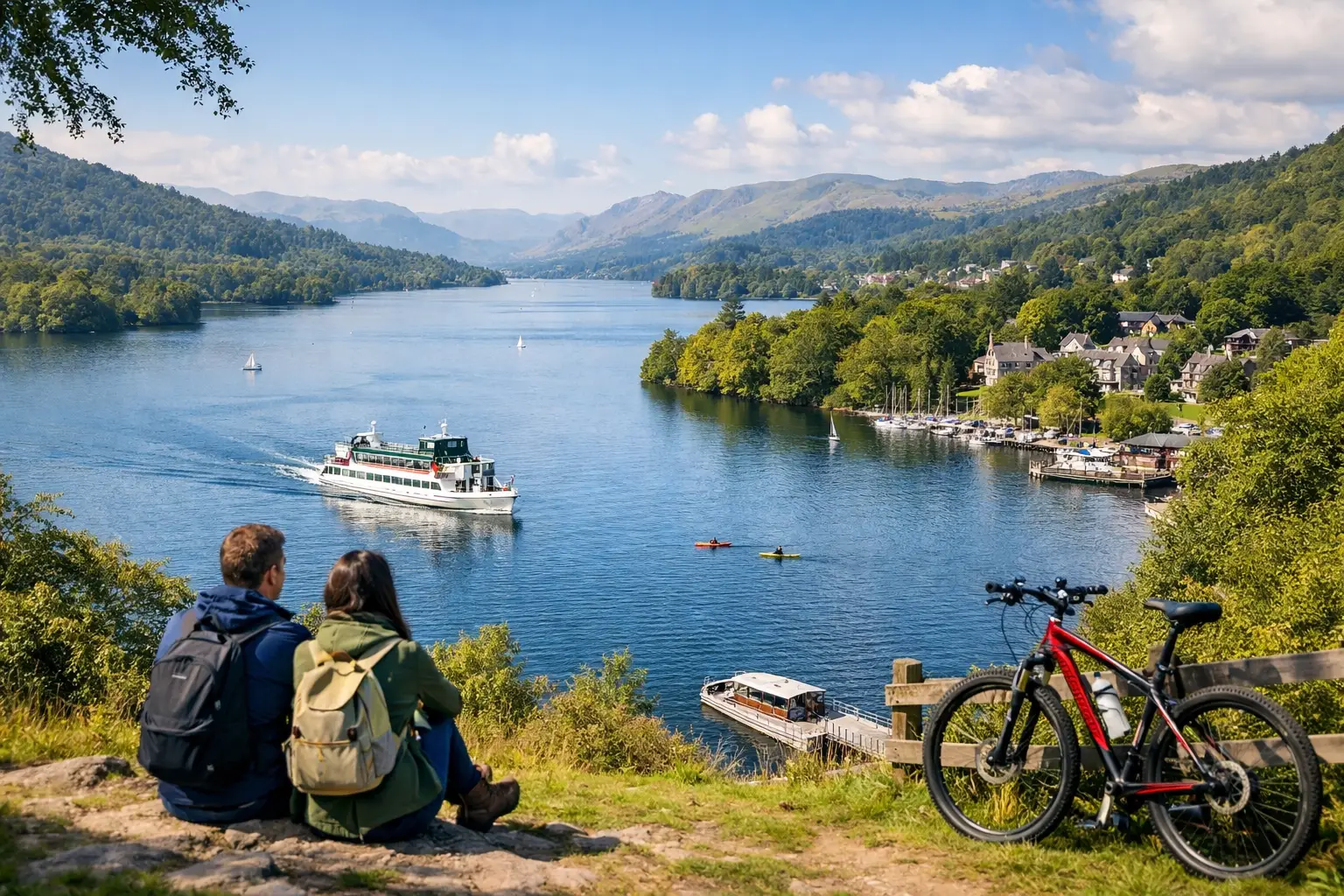
Local buses do a lot of the heavy lifting on a car-free Windermere trip. They connect the main settlements and are often the most realistic option for day-to-day travel. Boats are useful too, especially around the lake itself, and walking fills in the gaps.
Bowness, Windermere and Ambleside are connected by regular visitor-friendly routes in the busier seasons. That makes it easy to combine a lakeside morning with an afternoon in a different village. Boat services on Windermere also help turn transport into part of the day out rather than just a transfer.
Walking is more useful than many travellers expect. Bowness and Windermere are linked on foot, and there are plenty of accessible lakeside and village walks where you do not need a car to reach the starting point. Just be realistic about gradients, weather and daylight, especially outside summer.
Taxis have a place too. Even on a car-free trip, using one strategically can make sense – for example, to bridge a late arrival, bad weather, or an awkward transfer with luggage. Going car free does not have to mean refusing every other option on principle.
What you can realistically do without a car
A well-planned short break can still feel full. You can arrive by train, stay in Bowness or Windermere, spend time on the lake, visit Ambleside, enjoy walks with direct access from town, and build in one or two attractions without much difficulty.
This style of trip suits travellers who prefer a slower pace and do not need to pack five distant stops into one day. It also suits families who want straightforward logistics. Not having to load and unload the car repeatedly can be a relief, especially in busy school holiday periods.
If you want classic views without complex transport, a boat trip combined with time in Bowness and Ambleside is a solid option. If you enjoy walking, you can add shorter routes from your base rather than relying on remote trailheads. If the weather turns, central bases also give you more flexibility to change plans without wasting a long drive.
When a car-free Windermere trip may not suit you
There are situations where driving is simply easier. If you are travelling with toddlers and a lot of equipment, planning a photography-heavy itinerary at sunrise and sunset, or staying outside the main hubs, the convenience gap becomes much wider.
The same applies if your goal is to cover multiple less-connected areas in a single trip. Public transport can get you to a lot of popular places, but not always quickly, and not always on the schedule you would choose. In shoulder season or winter, reduced services can also affect what is realistic.
Mobility needs matter as well. A car-free trip can be comfortable for one person and frustrating for another depending on walking tolerance, luggage, and confidence using mixed transport. Practical planning beats idealism here.
Smart planning tips for visiting Windermere car free
The most useful thing you can do is treat transport as part of the booking process, not something to sort out later. Check where your accommodation sits in relation to the station, bus stops and the lakeside. A hotel that looks close on a map can still involve a steep climb or awkward road with bags.
Try to keep your itinerary compact. Instead of attempting the whole national park, focus on one main area and a few easy connections. This usually leads to a better trip anyway, because you spend more time enjoying the place and less time managing transfers.
It also helps to travel light. One cabin-sized bag or a manageable backpack makes station changes, short walks and bus boarding far easier. For lower-waste travel, a refillable water bottle and a few reusable basics are sensible additions, especially on walking days.
Finally, build in a bit of weather flexibility. Windermere is perfectly enjoyable in rain, but heavy weather can change walking plans quickly. On a car-free trip, that matters more because you are less able to improvise long-distance alternatives at the last minute.
So, can you visit Windermere car free?
Yes – and for many travellers, it is one of the most straightforward ways to do a Lake District short break. The area has enough rail, bus, boat and walkable infrastructure to make a simple, enjoyable trip very realistic, especially if you stay in Windermere, Bowness or Ambleside. The trick is not to force a car-free plan onto a car-dependent itinerary. Choose a central base, keep your plans focused, and use the transport options that already work well here. If you do that, Windermere is not just possible without a car – it can be calmer, cheaper and far less hassle. Plan around the place rather than against it, and the trip usually falls into place.