Europe Train First Holidays: Plan Your First Trip
A first rail holiday on the Continent is often easier than travellers expect, provided the route is kept realistic. Europe train first holidays work best when you choose two or three well-connected stops, allow time for changes and book the journeys that matter before fares rise. Trying to cover six cities in a week usually means more station time than holiday time.
For UK travellers, the appeal is clear: city-centre to city-centre travel, fewer airport transfers and a lighter environmental footprint than flying. The trade-off is that rail rewards a little preparation. A missed connection, an unfamiliar station layout or separate tickets can be manageable, but only if your plan leaves room for them.
Start Europe train first holidays with one simple route
For a first trip, begin with a direct cross-Channel train and build from a major rail hub. Brussels, Amsterdam, Cologne and Rotterdam are particularly straightforward starting points, while Brussels also makes a useful interchange for other Belgian and Dutch cities. Berlin, Vienna and Prague suit a longer break, but they need more travel time from Britain.
A good first itinerary has three qualities: each rail leg is usually no longer than three and a half hours, changes are limited, and you stay at least two nights in each base. This gives you time to see somewhere properly and protects the trip if one service runs late.
A sensible seven-night shape might be two nights in Brussels, three in Amsterdam and two in Cologne. Each place has central stations, frequent connections and enough to do without needing a car. If you would rather avoid moving accommodation often, choose one base and add day trips instead. Amsterdam to Utrecht or Brussels to Ghent are examples of short, low-stress journeys.
Do not choose destinations solely because they look close together on a map. A direct train of two hours can be far easier than a 90-minute journey involving two changes. Check the full door-to-door timing, including the walk or local transport from your accommodation to the station.
Choose tickets before you choose a rail pass
There is no single cheapest answer for every European rail holiday. Advance single tickets are often best for a fixed itinerary, especially on international and high-speed services. They can be very good value when booked early, but are less forgiving if your plans change.
A rail pass can suit travellers who want flexibility, are making several long journeys, or prefer to decide day trips as they go. However, a pass is not a free pass onto every train. Many high-speed and overnight services require a paid seat reservation, and the popular departures may sell out. Add reservation charges before deciding that a pass is cheaper.
For most first-time planners, compare the total cost of point-to-point tickets with the pass price, plus every reservation you expect to need. Also check whether your ticket is tied to a specific service, whether changes are allowed and what happens if a train is cancelled. Save confirmation numbers and tickets offline on your mobile phone, but keep key details written down as a backup.
Leave proper time for connections
When tickets are bought separately, give yourself a generous connection. Twenty minutes may work in a small station when everything is on time; it is not a comfortable allowance after an international arrival or at a large terminus. Aim for 45 to 60 minutes where possible, particularly on the first and last journey of the day.
If a route is sold as one through-ticket, missed-connection protection is generally clearer. If you have assembled separate tickets yourself, you may need to deal with each operator separately. The saving is sometimes worth it, but it should be a deliberate choice rather than an accidental risk.
Book accommodation for the station and the stay
A hotel beside a station is not automatically the best option, but a place within a short walk or direct tram ride can make a noticeable difference. On a two- or three-night stay, being near the centre usually saves more time than chasing the lowest room rate on the outskirts.
Before booking, check the exact station name. Large cities often have several stations, and the one used by your train may not be the central one. Look at the late check-in policy if your arrival depends on a final evening service, and confirm whether luggage storage is available before or after your stay.
Families and travellers carrying more bags may prefer a flat with a kitchen, but weigh that against location. A small supermarket near your accommodation can be more useful than a large kitchen a long way from the sights. For short breaks, convenience tends to win.
Pack for platforms, not just the weather
Rail travel is easier with luggage you can lift, wheel and manage alone. Stations can involve stairs, busy lifts and a quick walk along the platform when the carriage position changes. One medium case or backpack per person is a practical target, with a small day bag for passports, medication, chargers and water.
Pack layers rather than relying on one bulky coat. Train temperatures vary, and a lightweight waterproof is useful for city walking. A universal plug adaptor, power bank and comfortable shoes solve more everyday problems than extra outfits.
Lower-waste choices are simple here. Carry a refillable bottle, a reusable cup if you use one, and a small cutlery set or food container for picnic supplies. Buying bakery items, fruit and local food near the station can cut packaging and makes a change from expensive onboard snacks. Keep a compact tote bag for groceries and dirty laundry.
Plan the border and station routine
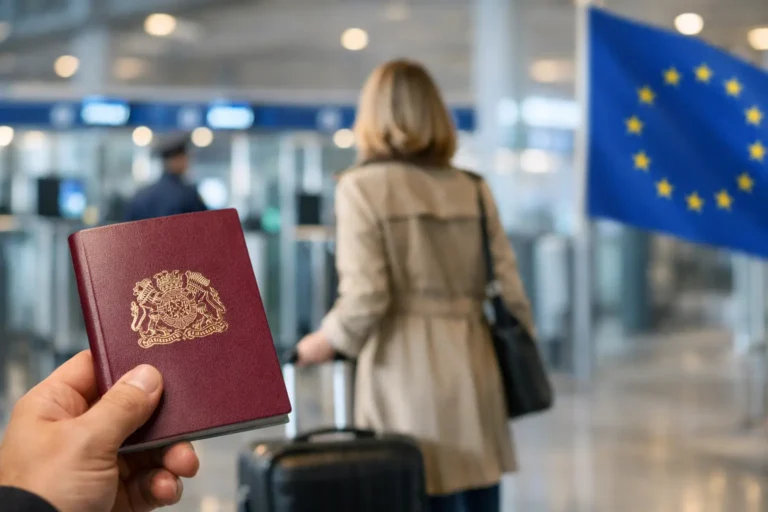
International rail still involves border checks, so arrive at the departure station with time to spare. Requirements can change, particularly for UK passport holders travelling into the Schengen area. Check passport validity, entry rules and any travel authorisation requirements for every country on your route shortly before departure.
Keep your passport, travel insurance details, payment card and booking references together in an accessible pouch, not at the bottom of your case. Download maps for each city before leaving Wi-Fi and make a note of your accommodation address in the local spelling. This helps with ticket machines, taxi ranks and asking for directions.
At stations, check the departure board again even when you have a reservation. Platforms can change. Board early when you have luggage, then store it without blocking aisles or doors. If you have a reserved seat, check both the coach number and seat number; a correct seat in the wrong carriage is still the wrong place.
Build a budget that includes the awkward costs
The headline train fare is only part of the holiday budget. Include cross-Channel travel, reservations, local transport, accommodation taxes, luggage storage, meals on travel days and any airport-style transfer needed at either end. A small contingency is worthwhile for a replacement ticket, a taxi after a late arrival or a hotel near a disrupted route.
You can keep spending under control by booking major rail legs early, choosing one paid attraction per day and using contactless local transport where it is accepted. But do not over-optimise every pound. A slightly more expensive morning service may give you a useful afternoon in your next city, while a very early departure can make the previous evening less enjoyable.
A realistic first-trip checklist
Before paying, make sure you have checked these essentials:
- Passport validity, entry requirements and travel insurance cover.
- Train-specific reservation rules and connection times.
- The correct arrival and departure stations in every city.
- Accommodation check-in times, local transport and luggage arrangements.
- Offline copies of tickets, addresses and emergency contact details.
The most enjoyable first rail holiday is rarely the one with the longest route. Pick places you genuinely want to spend time in, leave a little slack between trains and let the journey be part of the break rather than an obstacle to rush through.